This calendar is a research prototype based on the most accurate data we have been able to collect according to our biblical, scientific and agricultural research. We believe that we are to date the most accurate regarding the biblical Hebrew calendar of Antiquity.
This calendar uses Scaliger's chronology, which calculates the age of the Earth from Creation according to the Scriptures, as well as astronomical observation to determine the beginning of each month by the visibility of the first crescent moon.
⚠️ Important Warning: This calendar is a materialized study made available to the general public. We are not responsible for how people use this research. It is a study and reflection tool.
Our calendar is based on the barley harvest (Aviv maturity stage) to determine the beginning of the religious year. This method seems the most consistent so that at Passover (Pessach), the barley is well ripe, according to biblical and agricultural data.
Commandement biblique :
"Observe le mois d'Abib, et célèbre la Pâque en l'honneur de l'Éternel, ton Dieu ; car c'est dans le mois d'Abib que l'Éternel, ton Dieu, t'a fait sortir d'Égypte, pendant la nuit." — Deutéronome 16:1
The word Abib (אָבִיב) means "green ears" or "ripe barley". This indicates that the first month of the year must coincide with the ripeness of barley in Israel.
Historical Harvest Data (1911-1925)
Selon G. Dolman, source scientifique et académique la plus fiable :
| Year | Harvest start date (Jerusalem) |
|---|---|
| 1911 | 3 juin |
| 1913 | 21 mai |
| 1921 | 16 mai |
| 1925 | 24 mai |
Conclusion: The harvest begins between mid-May and early June, a delay of at least 1.5 months after April 3.
Modern and Official Agricultural Data (1983)
Une lettre datée de juin 1983, rédigée par N. Bar-Droma, alors Directeur du Département des Cultures de Plein Champ au Ministère de l'Agriculture israélien, fournit des informations précieuses sur les cycles de culture modernes :
"Both [wheat and barley] are sown as a rule, in November and the harvest starts around the end of April - the beginning of May. As stated, this year the first wheat and barley have been harvested not before mid of May in the Jordan Valley."
Le directeur note que l'année 1983 a été exceptionnellement froide et humide, retardant la récolte jusqu'à la mi-mai, même dans la vallée du Jourdain, la région la plus chaude. Il souligne également une différence cruciale entre les méthodes anciennes et modernes :
"In the ancient times... the crop could be harvested a couple of weeks earlier even if the barley would have been harvested with 20% moisture content."
Conclusion: Official data confirm that even with ancient methods that allowed an earlier harvest by two weeks, the start date of harvest in a normal year would be at the earliest in mid-April, not early April and even less in March.
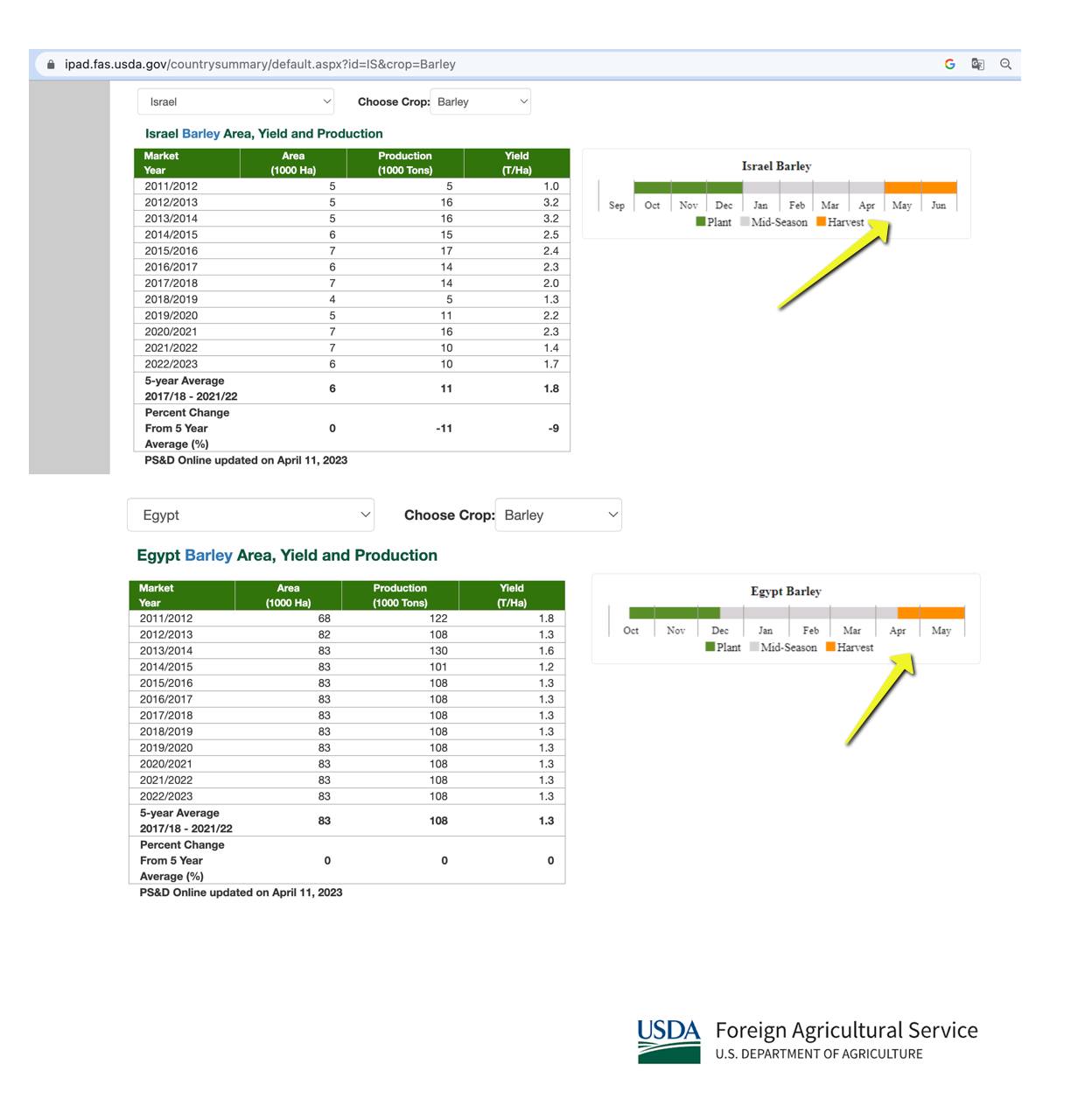
Source : USDA Foreign Agricultural Service - Données de récolte d'orge pour Israël et Égypte (2011-2023). Les graphiques montrent clairement que la période de récolte (Harvest) se situe en avril-mai pour les deux régions, confirmant les observations historiques de G. Dolman (1911-1925) et de N. Bar-Droma (1983).
📜 Historical Evolution of the Jewish Calendar
1. Le Calendrier Rabbinique de Hillel II (c. 360 apr. J.-C.)
Sous le patriarche Hillel II, le calendrier juif a connu une transformation majeure. Un calendrier fixe et calculé a été établi, lié à l'équinoxe vernal (printemps), ce qui a conduit à l'abandon de la méthode mosaïque basée sur l'observation de l'orge.
Conséquence : Les fêtes de Nisan, qui exigent une gerbe d'orge mûre, ont été déplacées dans la période des « pluies tardives » (mars), souvent un mois trop tôt par rapport à la maturité réelle de l'orge.
2. La Réforme Karaïte Médiévale (8e-10e siècle)
In the Middle Ages, the Karaite movement sought to restore the original Mosaic calendar based on the observation of barley and the moon.
Résultat : Dans ce secteur important du judaïsme, Nisan a été restauré pendant plusieurs siècles à sa position originale (avril-mai), après les pluies de mars, conformément à la période de récolte de l'orge.
💡 Our approach: This calendar follows the original Mosaic method based on the observation of ripe barley, which may result in a 1-month offset from modern rabbinic calendars that use fixed calculations.
The Hebrew calendar is luni-solar: it follows both the cycles of the moon (months) and the sun (seasons). To synchronize these two cycles, some years have a 13th month (intercalary month).
The Metonic Cycle (19 years)
The Metonic cycle is a 19-year cycle that synchronizes lunar years with solar years. Over 19 years:
- 12 années simples (12 mois lunaires)
- 7 années embolismiques (13 mois lunaires)
The leap years are years 3, 6, 8, 11, 14, 17 and 19 of the cycle. This ensures that biblical feasts always fall in the right agricultural seasons (e.g., Passover in spring, Sukkot in autumn).
The Barley Harvest Moon
The fundamental principle of the biblical Hebrew calendar is that the barley harvest moon always begins the year. This ensures that Passover (Pessach) and the waved sheaf (Omer) fall during the period of ripe barley.
- Nisan est appelé « ear moon » (lune des épis) ou « new fruits » (nouveaux fruits)
- The symbol of this month is the sickle (מגל), the harvest instrument
- L'orge est mûre en avril (Flavius Josèphe, Jahn, Buhle et Michaelis confirment que Nisan correspond à avril)
- The number of barley harvest years = the number of calendar years (no more, no less)
Intercalation and Prophetic Year
Intercalation (adding a 13th month) adjusts the lunar year to the solar year. The 19-year cycle includes:
- 7 années embolismiques (13 mois)
- Exactement 235 lunaisons sur 19 ans
- Chaque cycle a une séquence identique de 12 années simples et 7 années embolismiques
📜 Important note: A prophetic year is always a solar year in its fulfillment. The Jewish year does not have 360 days. The "360 days" is a prophetic symbol only. Ancient Jewish years had 354/355 days (simple) or 383/384 days (leap).
🌙 Link with harvest: The Metonic cycle and the addition of a 13th month ensure that the 1st of Abib (Nisan) always falls when barley is ripe in Israel, in accordance with the biblical commandment.
In the biblical Hebrew calendar, each day begins at sunset, not at midnight as in the modern Gregorian calendar.
Fondement biblique :
"Ainsi, il y eut un soir, et il y eut un matin : ce fut le premier jour." — Genèse 1:5
"From the evening of the ninth day of the month until the following evening, you shall celebrate your sabbath." — Leviticus 23:32
⚠️ Practical Explanation for Feasts
Important: In our calendar, the date displayed for a feast indicates the day it begins at sunset.
Concrete example:
If the calendar shows פֶּסַח (Passover) on May 1, 2026, this means that the feast begins on May 1 at sunset (beginning of the 14th of Aviv) and ends on May 2 at sunset.
Cette compréhension est essentielle pour bien se situer et observer correctement les jours de fêtes selon le rythme biblique.
Gregorian day
Minuit → Minuit (24h)
Hebrew day
Coucher du soleil → Coucher du soleil (~24h)
We have chosen to use Ngonda/Kondé in the Kikongo language, which means "moon" or "period" (like the duration of a lunar cycle).
Hébreu
- CHoDeSH/Hodesh (חֹדֶשׁ) = Mois
- CHaDaSH/Hadash (חָדָשׁ) = Nouveau, renouveau
- qadash/kadash (קָדַשׁ) = Saintifier
Kikongo
Ngonda = Lune ou Mois (cycle lunaire)
In Kikongo, "ngonda" primarily means "moon" and, by extension, "month".
According to some research, the Kikongo language would have similarities with Paleo-Hebrew, notably through the Lovo cave alphabet. These discoveries suggest ancient linguistic links between certain African peoples and the Hebrews of Antiquity.
Research note: This linguistic connection is part of our ongoing research.
Our calendar is based on the first visible lunation (the first crescent moon) to determine the beginning of each month. This method follows the biblical practice of eyewitness testimony, as it was practiced in ancient Israel.
Différence avec le calendrier fixe de Hillel II :
Contrairement au calendrier juif moderne fixé par Hillel II au IVe siècle, où les mois ont une durée fixe (29 ou 30 jours selon un calcul mathématique), notre calendrier suit l'observation réelle de la nouvelle lune. Ainsi, les mois n'ont pas toujours une durée fixe.
Cette méthode garantit une fidélité maximale aux pratiques bibliques originales et à l'observation astronomique.
This calendar is part of a messianic fulfillment vision. We believe that Jesus Christ is the Messiah who fulfilled the law and the prophets, and that through His Spirit, we can live according to biblical principles.
"Afin que la justice de la loi soit accomplie en nous, qui marchons non selon la chair, mais selon l'Esprit." — Romains 8:4
The new covenant does not consist in abolishing the law, but in fulfilling it through the Spirit of God. God writes His law in our hearts (Jeremiah 31:31-33; Hebrews 8:10), allowing us to live according to His commandments not by our own strength, but by the power of the Spirit.
L'exemple du Messie : Jésus-Christ est notre modèle. De nous-mêmes, accomplir la loi est impossible, mais par l'Esprit de Dieu qui habite en nous, nous pouvons marcher selon Ses voies.
The biblical feasts (mo'edim) retain their spiritual and prophetic significance, but no longer have the notion of offerings and animal sacrifices since the perfect sacrifice of Jesus Christ.
"Il fera cesser le sacrifice et l'offrande." — Daniel 9:27
Jesus is the perfect sacrifice and the mediator of a more excellent covenant (Hebrews 7:22-24). The sacrificial system of the Old Testament was fulfilled in Him (Hebrews 9-10).
Biblical references: Daniel 9:27; Hebrews 9-10; Hebrews 7:22-24
Ainsi, les fêtes bibliques sont observées comme des temps de célébration, de mémoire et de communion spirituelle, sans les rituels sacrificiels de l'ancienne alliance.
Historical Context
Paleo-Hebrew (also called ancient Phoenician script) is the original script used to transcribe biblical Hebrew. It is the script in which God (Yahweh) wrote the Ten Commandments on the stone tablets given to Moses at Mount Sinai.
This script was used by the Hebrews from the time of Moses (about 1400 BC) until the Babylonian exile (about 586 BC). The oldest manuscripts of the Torah, inscriptions on stones and royal seals all used Paleo-Hebrew.
Comparaison des Écritures
| Lettre | Paleo-Hebrew | Hébreu Moderne | Nom |
|---|---|---|---|
| 1 | 𐤀 | א | Aleph |
| 2 | 𐤁 | ב | Bet |
| 3 | 𐤂 | ג | Gimel |
| 4 | 𐤃 | ד | Dalet |
| 5 | 𐤄 | ה | He |
| 6 | 𐤅 | ו | Vav |
Note: Paleo-Hebrew did not use written vowels. Diacritical marks (vowels) were added to modern Hebrew much later.
Transition to Modern Hebrew
After the Babylonian exile, the Jews gradually adopted the square script (modern Hebrew), derived from the Aramaic alphabet. This transition was completed around the 2nd century BC.
However, Paleo-Hebrew continued to be used in certain sacred contexts. For example, the Tetragrammaton (YHWH) was sometimes written in Paleo-Hebrew in the Dead Sea Scrolls, even when the rest of the text was in square Hebrew, thus emphasizing the holiness of God's name.
Why Use Paleo-Hebrew?
En choisissant le paléo-hébreu comme écriture par défaut pour ce calendrier, nous honorons l'écriture originale dans laquelle Dieu a révélé Sa Parole à Moïse et aux prophètes. C'est un retour aux racines de la foi biblique et une connexion directe avec les Écritures telles qu'elles ont été écrites à l'origine.
« Et l'Éternel donna à Moïse, lorsqu'il eut achevé de s'entretenir avec lui sur la montagne de Sinaï, les deux tables du témoignage, tables de pierre, écrites du doigt de Dieu. » — Exode 31:18
Subscription fees are intended to improve this service and enrich our research. Your support allows us to:
- Maintain and improve the technical infrastructure of the calendar
- Pursue our biblical, historical and agricultural research
- Develop new features and study tools
- Make this calendar accessible to as many people as possible
We are grateful for every contribution that allows us to continue this work of research and sharing.